


UNK research program prepares students to be real-world problem solvers
KEARNEY – Some of the most valuable lessons at the University of Nebraska at Kearney aren’t taught in a traditional classroom.
They happen when students ask their own questions, investigate complex issues and discover how the knowledge they’re gaining can make a difference in the world.
That’s the idea behind UNK’s Undergraduate Research Fellows program, which gives students an opportunity to take ownership of their education while working alongside faculty mentors.
“It’s so outdated to only deliver PowerPoint presentations and lecture after lecture,” said political science professor Peter Longo. “Students need to own the endeavor, and sometimes that’s really hard in a classroom.”
Undergraduate research takes learning to another level, he believes, giving students greater independence and encouraging them to think critically about the issues they’re interested in.
“The students are the brilliant force in undergraduate research,” Longo said. “They are the world’s problem solvers. They are the ones who can take this knowledge and use it to solve the perplexing issues that confront our communities.”
Currently, 119 UNK students and 61 faculty members are participating in the Undergraduate Research Fellows program, which supports projects across a wide range of academic disciplines, from biology and chemistry to kinesiology and sport sciences, cyber systems, political science, psychology, education and the arts.
Open to full-time undergraduate students, the program provides a $1,200 annual stipend for research and creative activities related to their academic interests. Participants work closely with faculty mentors to develop research skills, explore topics beyond their coursework and complete projects that contribute to their fields of study.
For students such as Isabel Zaruba and Harrison Kuta, those experiences are also helping shape their future careers.
A Different Side of Medicine
A junior from Columbus, Zaruba is studying biology with a health science emphasis and minors in political science and public health. She’s part of the Kearney Health Opportunities Program (KHOP), which prepares students for careers serving rural Nebraska.
Her interest in undergraduate research began in Longo’s Politics and Policy of Health Care course, where discussions about healthcare access and health as a human right sparked questions she wanted to explore further.
“I was just really interested in a lot of the topics that we talked about,” she said. “I wanted to dive deeper into those issues and learn more about the barriers people face when trying to access healthcare.”
Zaruba started conducting undergraduate research during her sophomore year, completing projects in both political science and biology.
Working with Longo, she examined the potential impact of federal healthcare policy changes on rural Nebraska hospitals and healthcare delivery. She presented that research during UNK’s annual Student Research and Creative Activity Day, earning first place in the behavioral and social sciences category.
This year, she’s continuing to explore healthcare access through a project examining public attitudes toward conscientious objections by medical providers. Political science professor Satoshi Machida is also involved in that project.
Zaruba plans to attend medical school and become a physician. Her undergraduate research experiences have helped her discover new ways to make an impact in healthcare beyond treating individual patients.
“I think it’s really guided what I want to do with my career,” she said. “Medicine is often very science-driven, so you’re focused on biology and chemistry classes. But I’ve really found a niche in the legal and policy side of medicine. I want to explore that now so I can build a foundation for later.”
Zaruba views healthcare policy as an important part of addressing the challenges facing patients and providers, particularly in rural communities where access to care can be limited.
“Policy drives healthcare,” she said. “If you don’t have the insurance that’s necessary for a specific procedure, you’re not going to get it, so you might have a worsened health outcome simply because of the structures around you rather than how good of a provider you might have. I think it’s important to study those issues and try to fix them.”
The work she’s done at UNK has opened the door to opportunities far beyond campus.
Last summer, Zaruba participated in a competitive constitutional law program at Washington University in St. Louis before spending 11 weeks conducting policy research at St. Jude Children’s Research Hospital in Memphis, Tennessee. Her work at St. Jude focused on the “right to be forgotten” for cancer survivors, a legal principle that allows individuals to request the removal of certain personal information from online records and databases. She continues to collaborate with researchers there on a manuscript.
Zaruba hopes to combine clinical medicine with research and advocacy, eventually returning to rural Nebraska to practice as a physician.
She encourages other students to consider undergraduate research, even if they don’t envision themselves working in a laboratory.
“There are so many opportunities in research,” she said. “It really opens your mind to a new way of thinking, and I’ve appreciated what it’s given me.”
Longo, who’s mentored countless students through Undergraduate Research Fellows, called the program a “trademark” of the university.
The political science professor currently works with six students through the program and considers those relationships among the most rewarding aspects of his career. He’s quick to point out that he learns just as much from the students as they do from him.
“I’m just kind of a tagalong,” he said with a smile. “Every now and then I can answer a question correctly. I’m more impressed by their brilliance, and I feel really fortunate to have been associated with so many fine students.”
Putting Knowledge Into Practice
Undergraduate research has provided a different kind of learning experience for Kuta, a senior from Albion studying biology with a health science emphasis and chemistry minor.
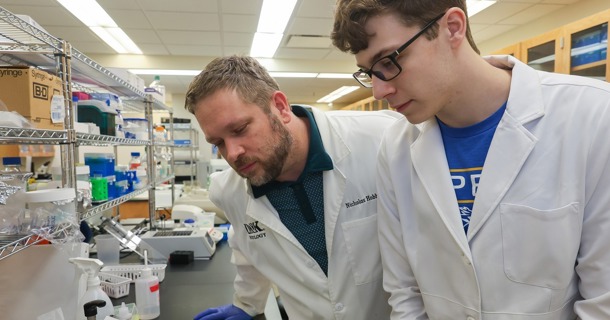
The pre-medical student is working with associate biology professor Nick Hobbs to investigate how food insecurity affects anxiety-like behavior and brain development in juvenile mice.
Their research addresses a widespread public health concern. According to the U.S. Department of Agriculture, 14.1 million American children lived in food-insecure households in 2024, meaning they lacked consistent access to enough food for an active, healthy life.
Children are particularly vulnerable to the effects of inadequate nutrition because their brains and bodies are still developing. Hobbs and Kuta hope their research will provide a better understanding of how food shortages influence stress, behavior and brain development, potentially informing efforts to reduce those impacts.
Kuta, another KHOP student who plans to attend medical school at the University of Nebraska Medical Center in Kearney, was initially drawn to research by a desire to better understand the scientific studies discussed in his classes. Now in his second semester as an Undergraduate Research Fellow, he’s gained hands-on experience collecting and analyzing data, interpreting results and presenting findings.
He’s shared his work at campus research events and conferences hosted by the Nebraska Academy of Sciences and Midlands Society of Physiological Sciences. His poster earned first place in the undergraduate division at the Midlands Society of Physiological Sciences meeting last month, and he’s helping prepare a paper for future publication.
“You learn all of these things in classes, and sometimes it can be hard to understand their importance,” Kuta said. “Through undergraduate research, you’re actually able to see how this knowledge is applied and have those aha moments.”
That experience is especially valuable for someone entering medicine, he noted, because physicians must continually evaluate new scientific findings and incorporate advances into patient care.
“As a doctor, one of the biggest things you have to do is keep up with modern research. It’s a rapidly evolving field,” Kuta said.
He also appreciates the significant responsibilities undergraduate researchers are given at UNK.
“At a lot of institutions, the level of work that I’m doing would only be available to graduate students,” he said, pointing to the opportunity to work directly with faculty members and contribute meaningfully to their research.
That close collaboration was one of the reasons Hobbs chose to teach at UNK.
As an undergraduate at the University of Kansas, he didn’t receive the mentorship and guidance he was looking for when pursuing research. Now, he’s committed to providing a different experience for his own students.
“I want to be the kind of mentor who’s there for their students and helps guide them and gets them to that level where they can be independent in the lab,” Hobbs said.
That mentorship benefits faculty members, too. Students bring fresh perspectives to research, according to Hobbs, often challenging him to consider ideas he might otherwise overlook.
“It’s a relationship that works both ways,” he said. “He’s pushing me to be a better mentor, and I think we both make each other better researchers.”
Longo shares that appreciation for undergraduate research, which he considers an essential part of UNK’s identity and campus culture.
“If they took away undergraduate research, they’d ruin the heart of the university,” he said.