


Loper Flight Academy launches new era for UNK Aviation
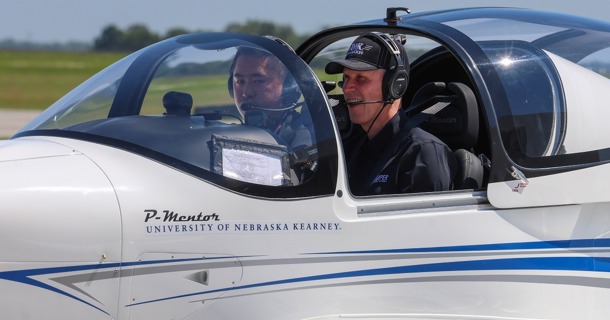
KEARNEY – Chancellor Neal Schnoor arrived in style Thursday to celebrate a new era for aviation at the University of Nebraska at Kearney.
He flew into Kearney Regional Airport aboard a brand-new Tecnam two-seat plane, with UNK graduate and assistant chief flight instructor Masahiro Suzuki alongside him as co-pilot.
The landing drew applause from a crowd of more than 200 people, who watched Schnoor step from the aircraft and shake hands with guests before heading into the hangar for a ribbon-cutting ceremony officially launching the Loper Flight Academy.
It was a fitting entrance for Schnoor, who earned his private pilot license 25 years ago.
“Today we celebrate opportunity – for our students to pursue careers in one of the nation's fastest-growing and most essential industries. For employers with a high demand for highly trained aviation professionals. And for Kearney and greater Nebraska as we innovate to meet education and workforce development,” Schnoor told the crowd, which included UNK students, staff and faculty along with community members, industry partners and representatives from the University of Nebraska System and local, state and federal government.
Fully owned and operated by UNK, the Loper Flight Academy represents a major expansion of the university’s aviation program and a new approach to flight training.
Instead of relying on a contracted flight school, UNK now oversees its own flight operations and employs its flight instructors, giving the university greater control over training, safety, scheduling and costs. The academy is leasing a fleet of seven new Tecnam P-Mentor aircraft, with the matching planes providing a modern and consistent training experience.
“This is exactly the kind of investment that defines UNK,” Schnoor said. “We identify workforce needs. We build strong partnerships. And we create educational opportunities that prepare students for meaningful careers while strengthening communities across Nebraska.”
Brooke Envick, dean of UNK’s College of Business and Technology, called the transition an important step in the continued growth of an aviation program that currently serves about 80 students.
“Universities have a responsibility to anticipate workforce needs and prepare students for the careers of tomorrow. That’s exactly what the Loper Flight Academy is all about,” she said. “As our aviation program continued to grow, we didn't ask, ‘How do we maintain what we have?’ We asked a much bigger question: ‘How do we build one of the premier collegiate flight academies in the United States?’”
The answer was a broader vision for UNK Aviation, centered on student success and Nebraska’s workforce needs.
“The Loper Flight Academy represents much more than airplanes and hangars. It represents vision. It represents partnership. It represents the confidence we have in our students and in the future of aviation in Nebraska,” Envick said. “Most importantly, it represents what UNK does best – creating opportunities that transform lives while serving the workforce needs of our state.”
Investing in students
The new operating model also creates opportunities to reduce flight-training costs for students.
Under the previous arrangement, UNK was subject to price changes from its third-party provider, with costs increasing each of the past four years. The university was also required to guarantee a certain number of flight hours for each aircraft every month, even when maintenance or weather prevented that plane from reaching the required total.
With the Loper Flight Academy, revenue generated through flight operations will remain with UNK and can be reinvested in the program. As enrollment and aircraft usage increase, university officials hope those efficiencies will translate into lower hourly flight-training costs and additional student resources, such as tutoring.
“By bringing flight operations in-house and introducing our new Tecnam aircraft, we are creating a stronger and more sustainable future for aviation at UNK,” said Dan Smith, an assistant professor of practice and director of UNK’s aviation program. “This allows us to better manage flight-training costs, reinvest resources directly into our students and expand opportunities for the students and communities we serve.”
Those community opportunities are another key component of the Loper Flight Academy.
The academy will offer both Part 61 and Part 141 flight training, serving UNK students pursuing professional pilot careers as well as community members interested in earning their pilot certificates. Opening the academy to non-UNK students expands access to flight training in central and western Nebraska while increasing utilization of the university’s aircraft, another factor that could help lower costs for students.
“Whether you are a UNK student pursuing a professional pilot career, someone considering a career change into aviation or simply someone who has always dreamed of learning to fly, the Loper Flight Academy is here for you,” Smith said.
UNK offers bachelor’s degrees in aviation with professional pilot and management emphases. Graduates can pursue careers as pilots as well as air traffic controllers, airport managers and aviation safety professionals or positions in areas such as aviation logistics and insurance.
Building partnerships
The academy’s reach extends beyond UNK, with a larger goal of strengthening Kearney’s position as a regional aviation hub.
UNK is working closely with the city of Kearney and Kearney Regional Airport as the academy grows. The city has partnered with the university on its airport facilities and lease agreement, supporting the investments and operational improvements accompanying the transition.
Another important partner is the Nebraska Safety Center, which is part of UNK. The academy will operate within the center, utilizing its existing structure, systems and expertise while creating opportunities to expand the center’s work into aviation safety.
“The partnership with the Nebraska Safety Center is especially important because it expands opportunities in aviation safety, workforce development and professional training across Nebraska,” Envick noted.
Smith sees that partnership as one piece of a much broader initiative.
“We want UNK and the Loper Flight Academy to be the first choice for students pursuing a bachelor's degree in aviation, as well as for community members who want to learn to fly outside of the university setting,” he said. “Through our partnership with the Nebraska Safety Center, Kearney will also become a destination for aviation safety education, consulting and professional services. Combined with the continued growth of aviation maintenance in our community, we are building something much larger than a flight school – we are helping establish a comprehensive aviation ecosystem that will serve Nebraska for years to come.”
That vision includes continued collaboration with local businesses and aviation partners, something flight program coordinator Clara Rios experienced firsthand as a UNK student.
Rios, who graduated from UNK in May with a bachelor’s degree in aviation, came to Kearney from Phoenix to compete on the Loper swim team. She later found a new passion through the aviation program, earning her private pilot certificate and gaining professional experience through opportunities at the airport.
“What I’ve valued most at UNK and in Kearney is the sense of community, and the desire to give back,” Rios said. “The programs here don’t just teach; they connect students to local businesses and real opportunities while they’re still in school.”
Now, she’ll help create those opportunities for future aviation students.
“I’ve seen what this program can do for students, and I want each new class to have even more opportunities than the one before them,” Rios said. “We want to keep giving back, growing and improving.”